Overview
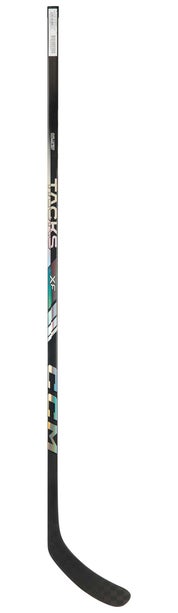
The CCM Tacks XF Stick is a game-changer for elite power shooters looking to shoot harder and more accurately for less. With a competitive price point and elite features inside and out, this stick should be a top choice for anyone seeking maximum shot power.
Not only does CCM utilize their modern mid-kick point that returns the most power out of any of their stick lines, but they're also incorporating the signature V-Geometry shaft design, which was previously only found on the top-end models. The V-shaped taper starting halfway down the shaft maximizes energy return, provides a truly ergonomic grip for the bottom hand, and ensures pinpoint accuracy by preventing taper twisting during big shots.
The AcuFeel blade, with its textured face, enhances puck control, passing accuracy, and confidence, allowing players to deliver the silky smooth setup pass or dangle when the team needs it most. While it has a softer feel for puck reception, the stiff design ensures accuracy by preventing the blade face from opening on big shots. To top it off, players gain better feel for the puck and a balanced grip in their hands with the high-end Sigmatex carbon fiber in the blade.
| OVERVIEW | |
|---|---|
| Level of Play | Elite |
| Flex Profile | Mid Kick |
| Weight | 413 grams (85 flex) |
| Heritage | Tacks AS-VI / Super Tacks AS-V / AS4 / AS3 |
| Model Number | HSXF |
| Available Flexes | 40, 50, 55, 65, 70, 75, 85 |
| (Note: All products are independently weighed and measured at IW Hockey with a 5% variance.) |
|
Specifications
| KEY TECHNOLOGIES | |
|---|---|
| Skeleton + Technology An advanced, refined construction process that sheds weight, improves energy transfer and enhances durability to the super precise final product. | |
| Sigmatex Carbon Fiber A truly elite material that is lighter, stronger and longer-lasting than standard carbon fiber. | |
| Variable V-Shape Geometry The unique v-shaped design on the lower half of the shaft creates more power, and better consistency while being lighter than standard tapers too. It also creates an extra sense of comfort and control for the lower hand, especially on big shots. |
| SHAFT | |
|---|---|
| Construction | Fused Two-Piece Pure Carbon Technology |
| Materials | Unidirectional Carbon Fiber |
| Grip Finish | Tacky, Textured Grip |
| Shaft Dimensions | Square Corners, Straight Sidewalls |
| Stick Lengths | 51" (40 Flex) 54" (50 Flex) 55" (55 Flex) 57" (65 Flex) 60" (70, 75, 85 Flex) |
| FLEX PROFILE | |
|---|---|
| Kick Point | Mid Kick Point |
| Shot Profile | Maximum Shot Power |
| Shaft Taper | V-Geometry |
| BLADE | |
|---|---|
| Construction | ACU-Feel Blade Core |
| Materials | Sigmatex Carbon Fiber Elite Foam |
| Face Texture | Textured |
| Available Curves | P28, P29, P88, P90TM (see all curves here) |
| MANUFACTURER WARRANTY | |
|---|---|
| Composite Stick | 30 Days |
| Contact | CCM Direct |
Videos
Sizing Chart
| GENERAL STICK FLEX AND SIZING RECOMMENDATION | |
|---|---|
| We recommend choosing the hockey stick flex that puts your specific height and weight at the middlemost point in both categories. A common rule of thumb is to select a flex rating by dividing your body weight in two and subtracting another 10-15 flex points. See the flex chart and articles below for more detailed information on sizing and selecting hockey sticks. |
| JUNIOR - CCM STICK SIZING AND FLEX CHART | ||||
|---|---|---|---|---|
| Size | Flex | Stick Length | Player Height | Player Weight |
| JR | 40 | 51" | 4'6" - 5'2" | 60 - 100 lbs |
| JR | 50 | 54" | 4'9" - 5'5" | 80 - 120 lbs |
| INTERMEDIATE - CCM STICK SIZING AND FLEX CHART | ||||
|---|---|---|---|---|
| Size | Flex | Stick Length | Player Height | Player Weight |
| INT | 55 | 55" | 5' - 5'8" | 90 - 130 lbs |
| INT | 65 | 57" | 5'2" - 5'10" | 105 - 145 lbs |
| SENIOR - CCM STICK SIZING AND FLEX CHART | ||||
|---|---|---|---|---|
| Size | Flex | Stick Length | Player Height | Player Weight |
| SR | 70 | 60" | 5'5" - 6'2" | 110 - 150 lbs |
| SR | 75 | 60" | 5'5" - 6'2" | 130 - 170 lbs |
| SR | 85 | 60" | 5'5" - 6'2" | 150 - 190+ lbs |
| (Note: Stick length is measured from the heel's point of contact with the playing surface to the top of the shaft.) | ||||
| HELPFUL ARTICLES | |
|---|---|
| How to Size a Hockey Stick | |
| How to Select a Hockey Stick | |
| How to Select a Stick Curve | |
| CCM Stick Curve Chart |